


ON ARCHITECTURE, CULTURE AND THE STORIES BENEATH
Ekaterina Juskowski is a curator, writer, and cultural critic. We met in Miami, one of the cities she calls home. She is currently researching a book about the city’s social and urban landscape and working on historic preservation in the Normandy Isles neighborhood.
What draws me to Ekaterina is the way she sees the world. She looks for an unexpected angle, reads the broader cultural context, and searches for the story beneath what is immediately visible.
When we sat together for this conversation, we naturally landed on Art Deco, the Miami of the 1940s, and how a building or a jewel can tell us something about the people who live with it.
WE HAPPEN TO SHARE AN INTEREST IN ART DECO. WHERE DID YOURS BEGIN?
EJ: My introduction to Art Deco came through ballet. I studied the Vaganova Method, which teaches a dancer to understand the cultural background of the music and the character being portrayed. Alongside our ballet training, we studied literature, music, film, and visual art to understand the worlds we were bringing to life on stage.
Among other things, I discovered the ballet costume designs of Erté (Romain de Tirtoff), a master of Art Deco aesthetics, and then the world of the Ballets Russes. The company's collaborations with figures like Léon Bakst, Pablo Picasso, Henri Matisse, Coco Chanel, and Igor Stravinsky, definitely influenced my appreciation of the same modernity and craftsmanship that defined the Art Deco era.
I remained marked by the way Art Deco drew inspiration from many different cultures and was arguably the first truly global design movement, reflecting the emergence of a new cosmopolitan world.


1) Costume Design Outlined in Feathers for "Ballet Africain," George White's Scandals, Erté, 1924 via The Met. 2) Clé N.5, 18K yellow gold, Sleeping beauty turquoise and Emeralds, photo by Ekaterina Juskowski.
WHAT DISTINGUISHES THE MIAMI ART DÉCO?
EJ: Miami and Art Deco are inseparable. Unlike many older cities, Miami came of age during the Art Deco era, so the movement became part of its identity from the very beginning. I think Art Deco became the architectural language of the city because it embodied Miami's optimism, ambition, and forward-looking spirit in the early twentieth century. The movement remained influential here much longer than in many other places, eventually becoming part of Miami's identity. Even today, Art Deco remains central to Miami's visual identity.
YOU’VE BEEN RESEARCHING A BUILDING FROM THE LATE 1940S, DESIGNED BY ROBERT SWARTBURG. HOW DID YOU BEGIN TO UNCOVER ITS STORY?
EJ: I am lucky to live there, and was part of the team that led the building’s historic restoration.
One of the most important Miami architect of his time, Robert Swartburg, bridged the Art Deco era and the rise of modernism. He was the architect behind some of Miami’s most important landmarks, including the Delano Hotel, the Bass Museum, and the Vagabond Motel.
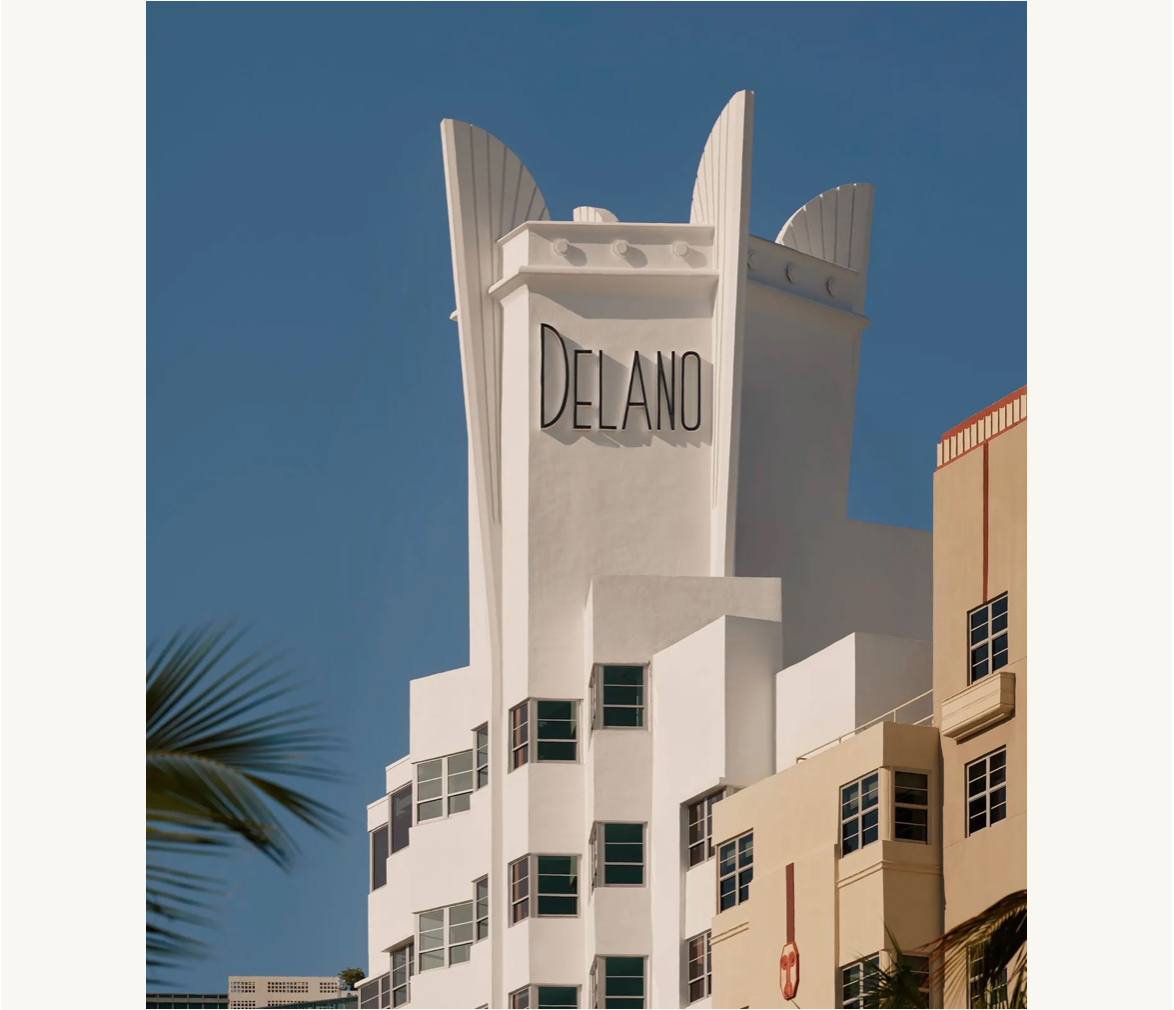
Details of the Delano Hotel
My building was designed by Swartburg around the same time as the Delano and opened just one year later. Its architecture combines Art Deco influences, streamlined modernist design and foreshadows the emerging MiMo aesthetic.
Relatively little documentation about the original design survived.
In order to fill in the gaps, I wanted to understand the social imagination of postwar Miami, Florida, America.
An advertisement for the building opening in the Miami Herald from 1948 became my starting point. I found myself wondering who would answer that ad. What would they wear? What kind of car would they drive? What music would be playing in their living room? It is remarkable how much you can discover by focusing on a single moment in history.

Details of a Robert Swartburg building, Miami.
I LOVE THAT YOU STARTED WITH THE PEOPLE WHO MIGHT HAVE LIVED THERE. WHERE DID YOUR RESEARCH TAKE YOU?
EJ: For me, the atmosphere of the 1948 Miami is portrayed in J. D. Salinger's A Perfect Day for Bananafish. The story captures a tension that feels very Floridian: on one hand, leisure, financial opportunities, and luxury; on the other, anxiety and alienation beneath the surface. In some ways, it does not feel very different from today.
If we were living in this building at the end of the 1940s, we would have the same Isamu Noguchi coffee table. We would be debating whether Jackson Pollock was a genius or a fraud, discussing Simone de Beauvoir's The Second Sex, listening to Nat King Cole's Nature Boy on the radio and leafing through Vogue, where Irving Penn was photographing Marcel Duchamp, Truman Capote, Georgia O'Keeffe, Salvador Dalí, and Duke Ellington.
In that sense, we can imagine Miami as the rest of America, only with more ambition, opportunity, visibility, and capital concentrated in one place. The architecture reveals how people lived and what they aspired to be.
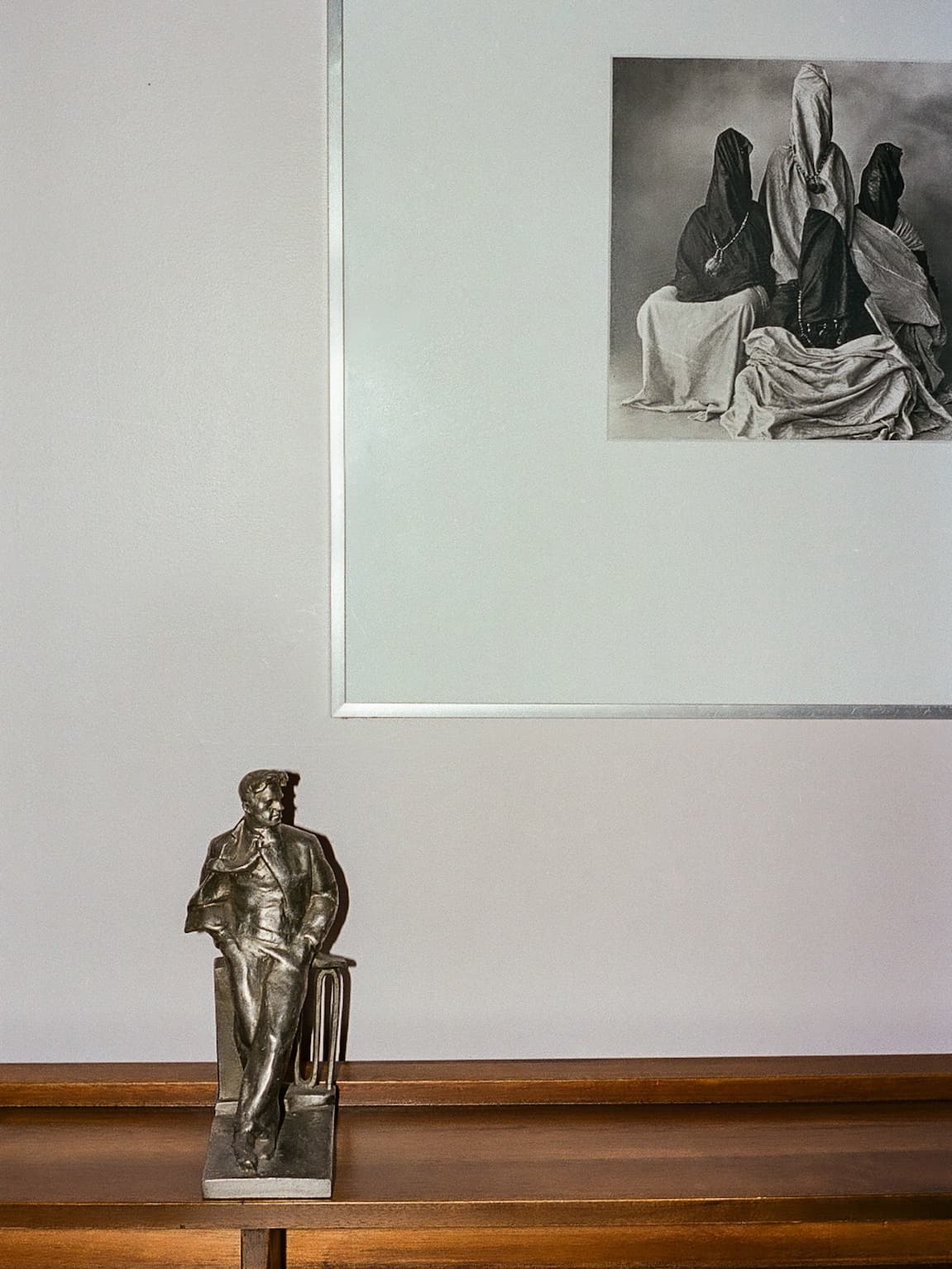
Statue of Vladimir Mayakowski next to a print by Irving Penn (1948) at Ekaterina's home.
YOU’VE MENTIONED OBJECTS AS A WAY INTO ANOTHER TIME. WHAT ROLE DOES JEWELRY PLAY IN YOUR OWN LIFE?
EJ: My relationship with jewelry is rather sporadic. I mostly wear pieces that are sentimental, connected to a person, a memory, or a particular moment in my life. My ears are not pierced, so I wear clip-ons, which tend to be statement pieces.
I was recently at an event where someone said, “I saw you and your earrings entering the room.” I thought it was funny because attention was exactly what I was in the mood for that evening.
Later, it made me think that jewelry is one of the most effective ways to communicate something about ourselves, but it invites a completely different kind of conversation than fashion. When we ask about a piece of jewelry, we never say “who are you wearing?" Jewelry is always closer to discussing a work of art than a fashion choice. Because it is chosen so deliberately, jewelry also has a much higher tolerance for resisting trends than fashion. I think jewelry reveals more about a person's values, aspirations, or cultural background. Your work, for example, lives outside of trends. For me your pieces communicate intelligence and connoisseurship. I would guess they appeal to people who are cultured, elegant, and who do not want to look like everyone else.
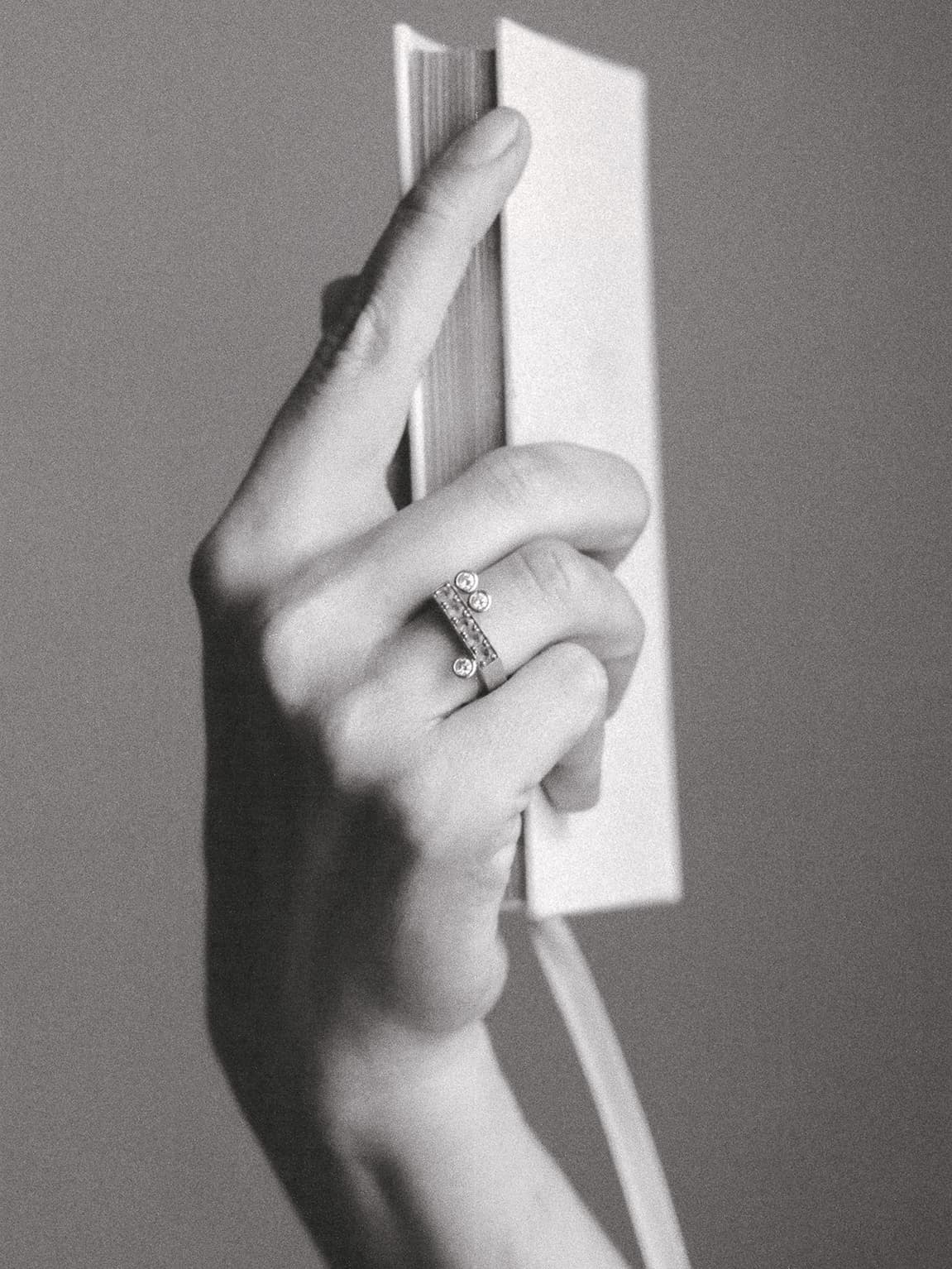
Ekaterina wears the Clé N.1 ring, 18K yellow gold, Emeralds and Diamonds.
BEFORE WE END THIS CONVERSATION, IS THERE A PROJECT YOU´RE WORKING ON THAT YOU'D LIKE TO TELL US ABOUT?
EJ: Yes. Mnemosyne Projects is continuing to grow. We have just added our second artist residency on the island of Hydra, and this fall we are moving beyond Greece for the first time with a project in Buenos Aires.
Drawing on Argentina’s surrealist legacy, the exhibition will explore the country’s cultural history alongside the myths, hidden narratives, and alternative forms of knowledge that have shaped it.
It feels like the beginning of a new chapter for the project. Please follow along.
